Supreme Court Examines Whether Legislators Who Resign to Switch Parties Should Bear By-Election Costs
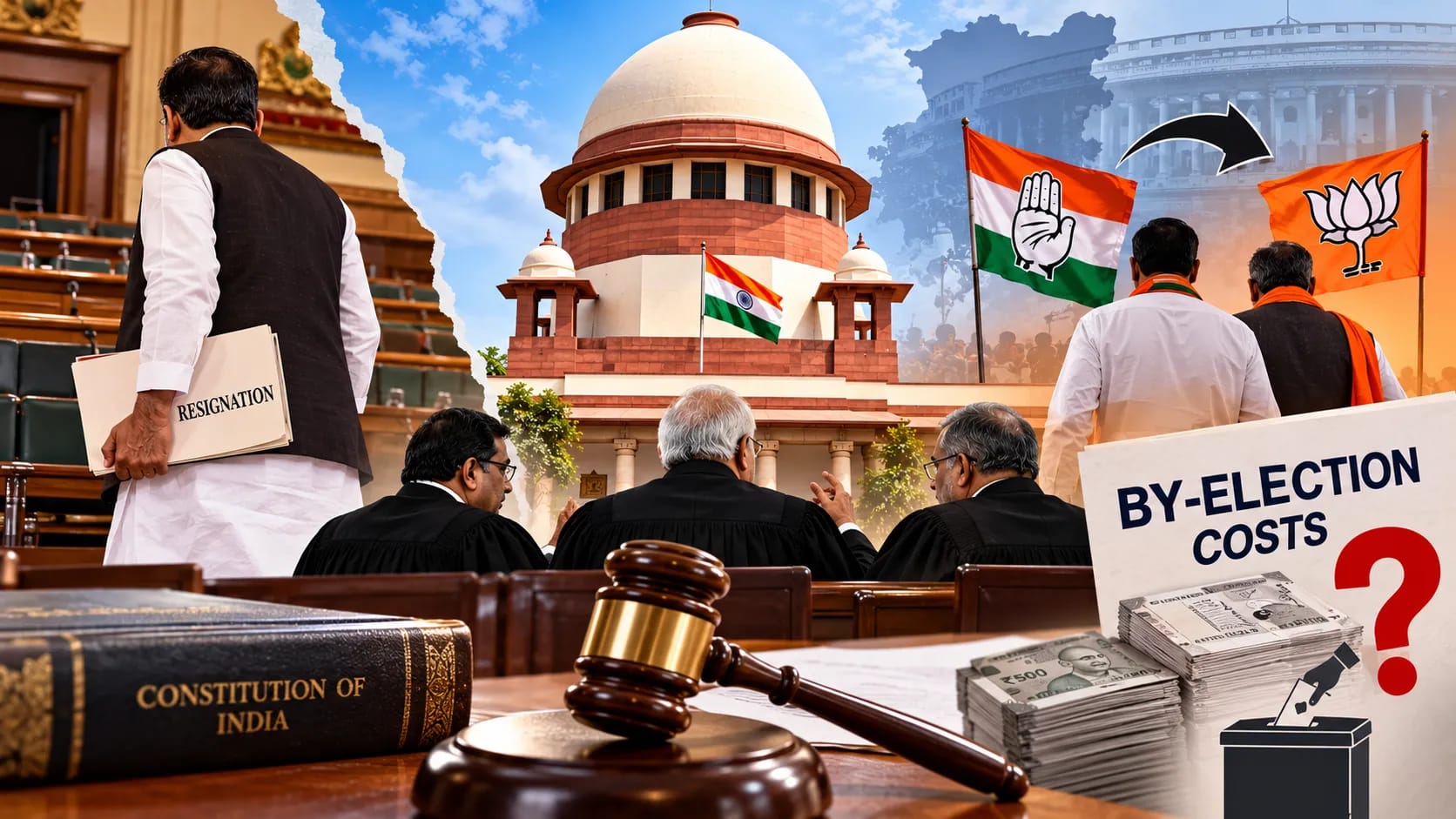
The Supreme Court has agreed to examine whether elected representatives who voluntarily resign from their seats and trigger by-elections should be required to bear the cost of the additional election. The proceedings could have implications for political defections and the practice of legislators leaving their elected positions before seeking another mandate.
The issue came before a bench led by Chief Justice of India Surya Kant, alongside Justices Joymalya Bagchi and V. Mohana. Reports published on October 27 said the court had sought responses from the Union government and the Election Commission in proceedings concerning legislators who resign and subsequently contest by-elections.
The court has not imposed a new penalty or introduced a cooling-off period. The matter remains under consideration.
Why the petition matters
By-elections are held when an elected seat becomes vacant before the end of its term, subject to the applicable constitutional and legal requirements. Vacancies can arise for several reasons, including death, disqualification and resignation.
The petition raises a specific concern about representatives who voluntarily resign after being elected and then change their political allegiance. Its argument centres on whether such conduct can place unnecessary financial burdens on the public by requiring another election soon after the original one.
A separate election involves public administration, security arrangements, election staff and other expenses. However, whether those costs can legally be recovered from a former legislator is a question that requires judicial and legislative consideration.
The issue of political defections
Party switching has been a recurring feature of Indian politics. Legislators may leave a party because of disagreements over leadership, policy or political alliances. In some cases, resignations have changed the balance of power in legislative assemblies and led to fresh elections in affected constituencies.
India’s anti-defection framework, contained in the Tenth Schedule of the Constitution, addresses specified circumstances involving legislators changing political allegiance. The current proceedings raise a related but distinct question: what consequences, if any, should follow when a representative resigns voluntarily and the resignation results in a by-election?
The court will need to consider the limits of existing law and the relief sought by the petitioners. A judicial order cannot be assumed in advance, and any proposed restriction must be assessed against constitutional provisions governing elected representatives and elections.
Public mandate and accountability
The case also raises a broader democratic question about the relationship between a legislator and the voters who elected them. Voters choose representatives to serve for a legislative term, but political circumstances can change during that period.
Supporters of stronger accountability argue that avoidable resignations may require citizens to vote again and impose additional expenses on the public. Others may argue that elected representatives should retain the ability to resign and that the legal consequences must remain consistent with constitutional rights and established procedures.
The court’s examination will require balancing these considerations rather than assuming that every resignation is politically motivated or improper.
What to watch next
The next significant development will be the responses submitted by the Union government and the Election Commission, followed by any further directions from the court. The final outcome could clarify whether existing legal provisions provide a remedy or whether the issue requires legislative action.
Conclusion
The Supreme Court proceedings place political accountability and election expenditure at the centre of a wider debate about representative democracy. The case does not establish that resigning legislators must repay election costs. Instead, it opens a legal examination of what rules should apply when voluntary resignations lead to additional polls.
The eventual outcome may influence future discussions about political switching, the responsibilities of elected representatives and the cost of conducting elections.


Join the discussion
Comments (0)