Kotia Dispute 2026: Mohan Majhi vs Naveen Patnaik as Odisha–Andhra Pradesh Border Row Intensifies
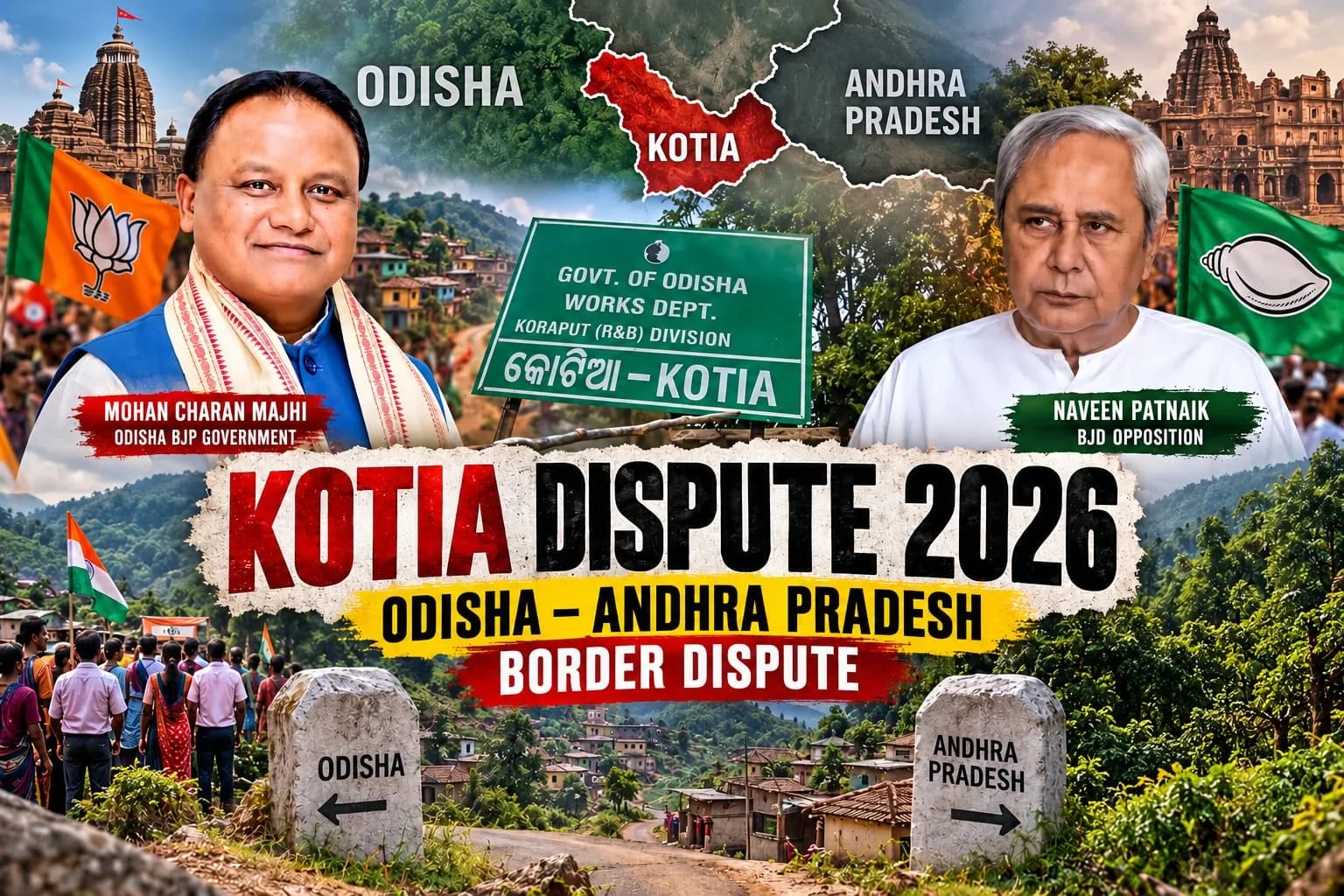
A border dispute returns to the centre of Odisha politics
A long-standing territorial dispute involving Odisha and Andhra Pradesh has entered a fresh political phase after Chief Minister Mohan Charan Majhi responded to a letter from Biju Janata Dal president and Leader of Opposition Naveen Patnaik.
In his letter dated 27 October 2026, Majhi reiterated the Odisha government’s position that the Kotia group of villages forms part of Odisha. He also called for restraint, respect for the judicial process and constructive engagement to address the dispute.
The exchange follows Patnaik’s earlier communication dated 19 October, in which he raised concerns about the state government’s handling of the issue. Contemporary reports say the disagreement intensified amid concerns over Andhra Pradesh’s plans to conduct local-body elections in the disputed area.
Majhi’s response framed the matter as one requiring legally sustainable solutions rather than political confrontation. He also invited Patnaik to submit proposals that could be considered by the government.
The development is significant for Odisha politics because it brings the BJP-led state government and the BJD opposition into a public debate over territorial integrity, administrative responsibility and the interests of residents in a sensitive border region.
What is the Kotia dispute?
The Kotia group of villages lies in the Koraput district region along the Odisha–Andhra Pradesh border. The area has been the subject of a long-running inter-state boundary dispute, with competing administrative claims and concerns about the delivery of public services.
The issue extends beyond the drawing of a line on a map. Residents in disputed border areas can face overlapping claims involving government administration, public welfare schemes, local institutions and the provision of essential services.
What did Mohan Majhi say?
According to reports published on 27 October, Majhi acknowledged receiving Patnaik’s letter of 19 October and reaffirmed the state government’s commitment to safeguarding Odisha’s territorial integrity.
He stated that the Kotia group of villages had been part of Odisha since the formation of the separate state in 1936.
Majhi also criticised the approach taken in Patnaik’s letter, saying that it appeared to address the issue from a political standpoint rather than advance constructive and legally tenable solutions.
The Chief Minister’s response highlighted three areas of action:
Protecting Odisha’s territorial interests through lawful and constitutional channels.
Continuing development initiatives in Kotia and neighbouring areas.
Encouraging responsible political engagement and respect for the judicial process.
Majhi also referred to a committee headed by the Revenue and Disaster Management Minister, with senior officials involved, to oversee the integrated development of the Kotia Gram Panchayat areas.
Why has Naveen Patnaik raised the issue?
The BJD, now in opposition in Odisha, has questioned the state government's handling of the territorial dispute. Reports on the exchange say Patnaik raised concerns about Andhra Pradesh’s proposed local-body elections in the disputed area and the state government's response.
For the opposition, the central political question is whether the state government is taking sufficient steps to protect Odisha’s claims and residents’ interests.
The government, meanwhile, has emphasised legal procedures and development initiatives rather than treating the matter as a dispute that can be resolved through political statements alone.
A balanced account must distinguish between the two sides’ political arguments and the legal position. Patnaik’s criticism is not, by itself, proof that the state government has failed to protect Odisha’s interests. Similarly, Majhi’s reaffirmation of Odisha’s claim does not, on its own, resolve the dispute.
The key question is what legal, administrative and practical measures the governments take next.
Why development in Kotia matters
Territorial claims are only one part of the problem. The welfare of residents is an equally important concern.
People living in border villages need dependable public services, including schools, healthcare facilities, transport, drinking water and access to welfare programmes. Where competing administrations operate or make overlapping claims, the delivery and coordination of these services can become politically sensitive.
Conclusion: Can political disagreement lead to a practical solution?
The renewed exchange between Mohan Charan Majhi and Naveen Patnaik has brought the Kotia dispute back into Odisha’s political spotlight. The Chief Minister has reiterated the government’s territorial claim, highlighted development initiatives and invited constructive suggestions from the opposition leader.
The larger question is whether the political exchange leads to documented legal progress, better coordination between authorities and improved services for residents.
Join the discussion
Comments (0)