
Kerala Congress Deletes Post Calling for CJI Surya Kant's Resignation, BJP Criticises Party
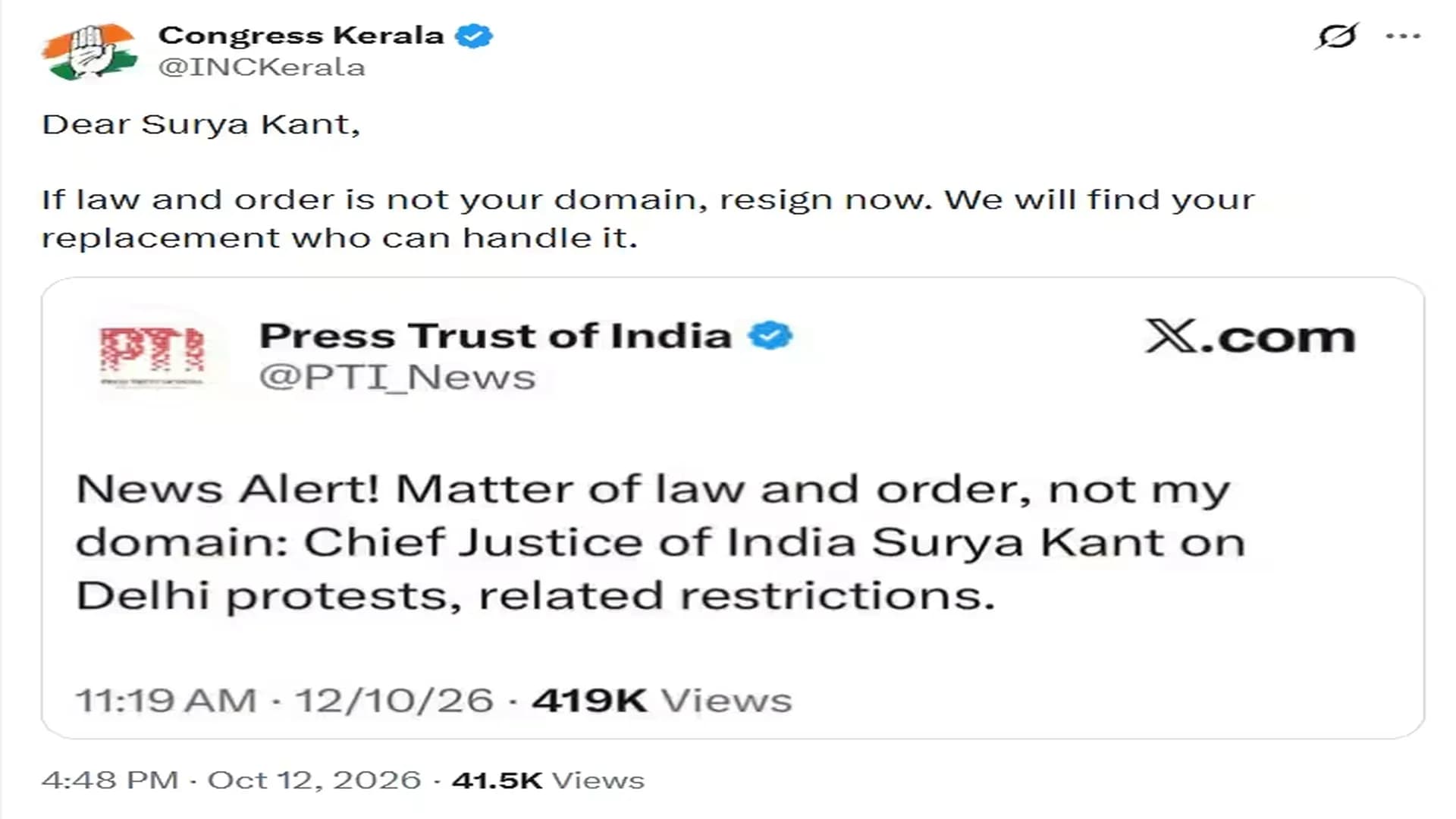
Deleted Social Media Post Triggers Political Controversy
The Kerala unit of the Indian National Congress has faced intense political scrutiny after publishing and subsequently deleting a social media post calling for the resignation of Chief Justice of India Surya Kant. The episode, reported on October 13, has drawn widespread national attention to the increasingly sharp political exchanges surrounding the highest offices of the Indian judiciary and constitutional authorities like the Election Commission of India.
The initial communication suggested that an alternative leadership or replacement for the Chief Justice could be sought in light of ongoing judicial proceedings. Although party managers acted swiftly to pull down the post within a short interval, its deletion did not prevent a major political storm. Key leaders from the Bharatiya Janata Party (BJP) seized upon the messaging, characterizing it as a deliberate effort to intimidate and discredit constitutional institutions when verdicts or legal stances do not align with partisan expectations.
This incident has emerged against the backdrop of a broader, high-stakes confrontation between various opposition parties and the Election Commission regarding the management and integrity of electoral rolls across multiple states.
Background to the Dispute and Legal Interventions
The controversy traces its roots to escalating tensions over the Special Intensive Revision of electoral rolls. For several weeks, opposition leaders have voiced significant concerns over large-scale discrepancies, procedural anomalies, and the alleged wrongful deletion of legitimate voter entries. Representatives across political parties have argued that these roll revisions disproportionately impact vulnerable demographics and require immediate judicial scrutiny.
On October 12, a coalition of opposition parties formally approached the Supreme Court of India seeking urgent intervention, transparent oversight mechanisms, and directives to freeze contested administrative processes pending thorough review. During preliminary hearings, judicial observations emphasized the necessity of procedural adherence while cautioning litigants against turning the apex courtroom into an ideological or political battleground. Chief Justice Surya Kant reiterated that constitutional courts operate strictly within statutory frameworks, evidence, and established constitutional doctrine rather than political narratives.
The Kerala Congress post appeared precisely when public attention was fixated on these high-profile hearings. The timing fueled immediate speculation about whether the post represented an impulsive reaction by a digital communication team or a coordinated escalation aimed at questioning judicial neutrality. Official spokespersons have since maintained that formal positions can only be established through structured press releases rather than fragmented digital updates.
BJP Criticises Congress Over Institutional Respect
The reaction from the ruling BJP was swift and coordinated. Senior spokespersons framed the controversial remarks as part of a recurring pattern where opposition factions question constitutional authorities whenever institutional decisions prove disadvantageous to their political strategies. BJP leaders argued that publicly demanding the resignation of the Chief Justice sets a damaging precedent, weakens democratic norms, and erodes citizens' faith in the rule of law.
Party representatives highlighted the distinction between legitimate legal debate and attacks directed against individual judicial officers. They asserted that while every citizen and political entity possesses the right to appeal rulings and critique judicial philosophy, calling for the summary exit of a sitting Chief Justice threatens the independence that shields the judiciary from external pressure. The controversy has thus provided political opponents an effective rhetorical opening to scrutinize the Congress party's messaging discipline, internal coordination, and institutional philosophy.
Distinguishing Party Messaging from Digital Overreach
Navigating modern political communication requires drawing a clear line between the broader policy critique of a national party and unverified statements posted by regional communication wings. The Congress party's central stance regarding electoral fairness, voter verification safeguards, and institutional transparency constitutes a major constitutional critique with widespread participation from senior advocates and legal scholars.
However, the specific social media post calling for judicial resignations stands completely detached from structured legal arguments presented inside the courtroom. A deleted digital broadcast cannot unilaterally define the long-term institutional doctrine of a political party that has governed the nation for decades.


Join the discussion
Comments (0)