
Sikkim Takes Centre Stage! Lalan Singh's Gangtok–Mangan Visit Puts Modi Government's Northeast Development Agenda Under the Spotlight
New Delhi's Northeast strategy puts Sikkim in focus
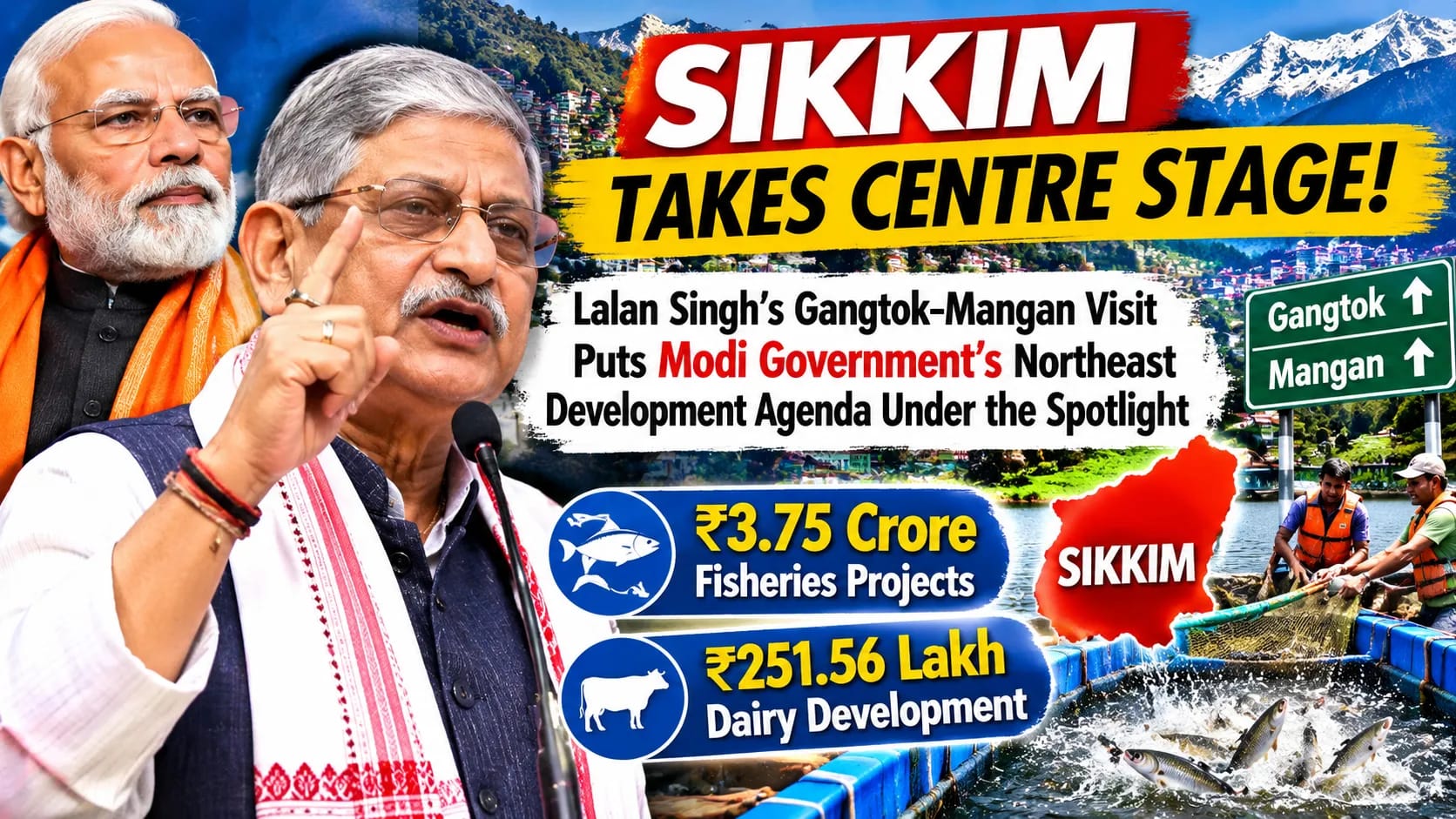
Sikkim has attracted national attention following the scheduled visit of Union Minister Rajiv Ranjan Singh, popularly known as Lalan Singh, to Gangtok and Mangan on 2–3 November 2026.
The visit has become significant for the state's political and administrative landscape, with the Union Government announcing a series of initiatives covering fisheries, dairy development and cooperative institutions.
Two separate announcements from the Ministry of Fisheries, Animal Husbandry and Dairying through the Press Information Bureau have highlighted the Centre's development programme in the state.
The first announcement, dated 1 November, outlined fisheries projects worth ₹375 lakh under the Pradhan Mantri Matsya Sampada Yojana (PMMSY). The second, published on 2 November, announced dairy development initiatives worth ₹251.56 lakh.
The developments place Sikkim at the centre of the Union Government's wider Northeast development strategy.
The visit also reflects the Centre's mechanism of sending Union Ministers to northeastern states to review government programmes and collect feedback from local stakeholders.
For the Modi government, the initiative provides an opportunity to demonstrate administrative engagement with the region. For the Sikkim government, it creates an opportunity to coordinate with central ministries and strengthen implementation of national schemes.
However, the real political test will be whether the announcements translate into visible improvements for residents.
₹3.75 crore fisheries projects bring central policy into focus
One of the major announcements concerns fisheries development projects worth ₹3.75 crore under PMMSY.
The programme includes the launch of a Standard Operating Procedure for organic fish farming, distribution of Kisan Credit Cards to fish farmers and financial assistance cheques under the Mukhya Mantri Matsya Uthpadhan Yojana.
The Union Minister is also scheduled to interact with fish farmers and cooperative representatives at the Live Fish Vending Centre in Mangshila.
The programme highlights the Centre's effort to connect national fisheries policies with local requirements.
The government's cluster-based approach includes production, processing, value addition and marketing. Sikkim and Meghalaya have been identified among the states with organic fisheries clusters.
Dairy development: Another major announcement
The PIB announcement dated 2 November adds another important dimension to the visit.
The Union Minister is scheduled to inaugurate a microbiology laboratory for the Sikkim Milk Union under the National Programme for Dairy Development.
The programme also includes:
Establishment initiatives for 57 new Dairy Cooperative Societies under White Revolution 2.0.
Registration certificates for five newly registered cooperative societies.
Initiatives for establishing 15 additional societies in North Sikkim.
A traceability initiative for Churpi cheese produced in Gangtok and Jorethang.
Promotion of two Fodder Plus Farmer Producer Organisations under the Centre's 10,000 FPO Scheme.
Centre–State coordination under scrutiny
The visit raises a wider question about Centre–State relations.
Central government schemes require effective coordination with state departments, district administrations and local institutions.
In Sikkim, the geographical challenges of remote settlements make implementation particularly important.
The Union Government may announce funding and policy support, but the state administration must ensure that eligible beneficiaries receive assistance.
Both levels of government therefore have responsibilities.
The Centre must monitor its schemes, while the state must ensure transparency, timely implementation and proper use of public funds.
Why the visit matters politically
The Modi government's Northeast development strategy has repeatedly emphasised infrastructure, institutional coordination and greater administrative attention to the region.
Lalan Singh's visit provides another opportunity to review this approach.
It also brings attention to the political relationship between national development commitments and state-level delivery.
The Sikkim programme is not simply about announcing projects. It is about assessing whether central policies can respond effectively to local requirements.
Opposition parties and public representatives can legitimately examine project expenditure, beneficiary selection and implementation progress. However, no unverified party reactions should be attributed to them.
What happens next?
The important developments to watch include official confirmation of the projects inaugurated, details of the beneficiaries receiving assistance and the administrative follow-up from the minister's district-level meetings.
The performance of the newly announced cooperative initiatives will also be important.
The government should provide transparent information about implementation and project outcomes.

Join the discussion
Comments (0)