Odisha–Andhra Pradesh Border Dispute Escalates: Police Face-Off, Public Protests and Tension Over Kotia Elections
With both state governments asserting their administrative rights over the region, the situation has raised fresh questions about border security, political responsibility and the future of residents living in the disputed villages.
What Is the Kotia Border Dispute?
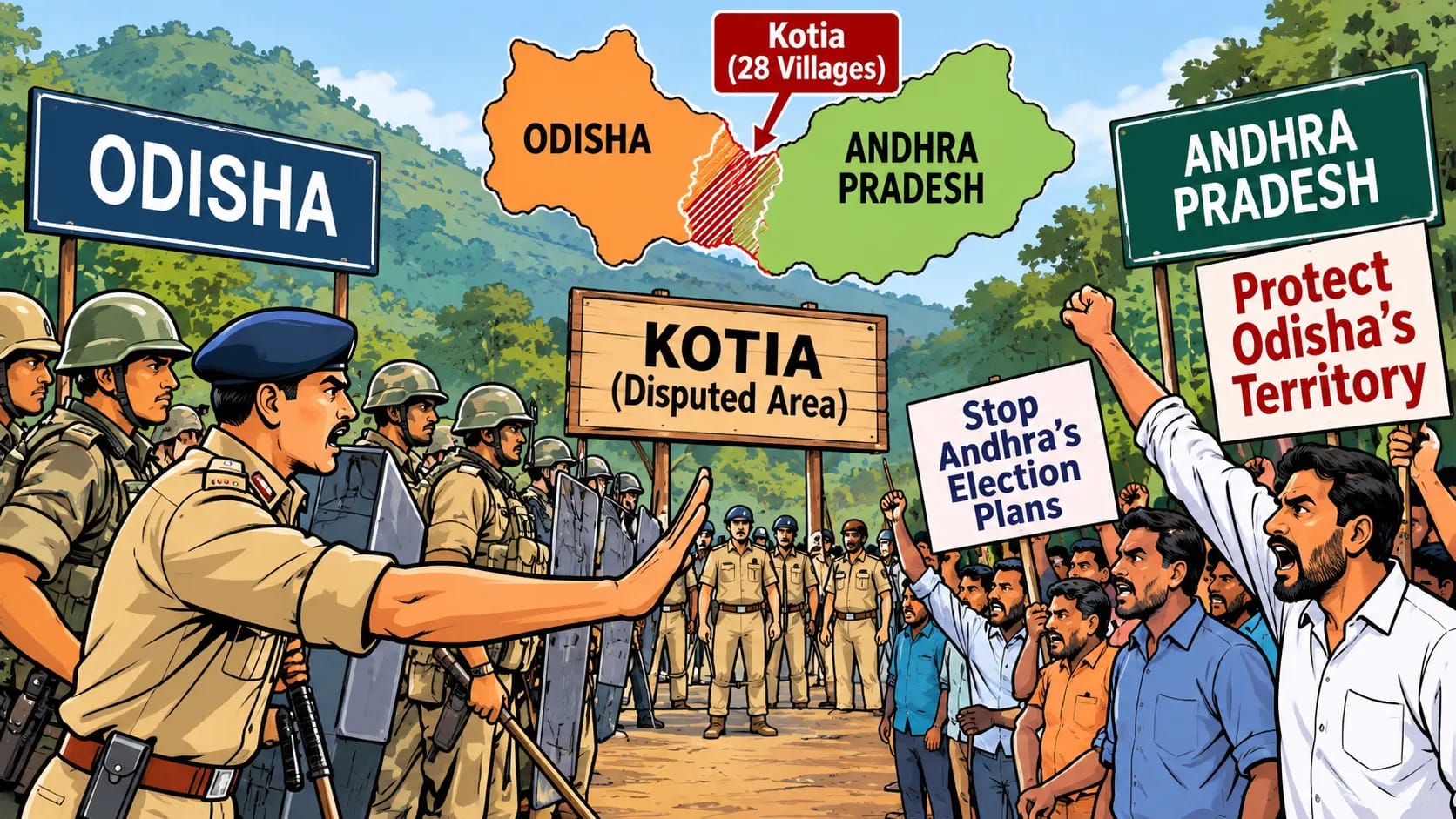
The Kotia region is located in the Pottangi block of Koraput district in Odisha, along the Andhra Pradesh border. It consists of 28 villages with a population of approximately 5,000 people.
The dispute has continued for decades, with both Odisha and Andhra Pradesh claiming administrative control over 21 villages in the region.
Both governments have attempted to establish their influence by providing welfare schemes, infrastructure, public services and administrative facilities to local residents. As a result, people in the region have experienced overlapping political and administrative claims.
Andhra Pradesh's Election Decision Triggers Fresh Controversy
The latest controversy erupted after Andhra Pradesh announced local body elections in disputed Kotia villages.
Odisha strongly opposed the decision, arguing that conducting elections in the disputed territory would challenge its administrative authority.
Police Confrontation and Protests in Kotia
The situation became more serious when police personnel and administrative officials from both states reportedly faced a confrontation over election-related activities.
According to reports, Andhra Pradesh police personnel allegedly attempted to cross barricades established by Odisha authorities. The incident resulted in heated arguments between officials from the two states.
On November 4, hundreds of people, including women, gathered in Kotia to protest against Andhra Pradesh's proposed elections. Protesters reportedly pulled down barricades erected by Andhra Pradesh police.
Koraput police also took control of an Andhra Pradesh police checkpost at Upper Sembi village. According to Koraput DSP Sanjay Kumar Mandal, Andhra Pradesh police personnel vacated the checkpost after Odisha police arrived.
To prevent further escalation, Odisha deployed additional police personnel and imposed prohibitory orders under Section 163 of the Bharatiya Nagarik Suraksha Sanhita.
Odisha Takes Legal and Administrative Steps
Odisha has maintained that the Kotia dispute should be resolved through legal and constitutional procedures rather than competing administrative activities.
The state government has indicated that it will pursue contempt proceedings in the Supreme Court over Andhra Pradesh's decision to conduct elections in the disputed villages.
Odisha has also referred to the Supreme Court's earlier direction to maintain the status quo in the region.
The state administration has increased surveillance, deployed senior officials and taken steps to prevent any law-and-order situation.
Political Leaders React to the Border Tension
The Kotia controversy has also become a political issue within Odisha.
Former Chief Minister and BJD president Naveen Patnaik has questioned the state government's handling of the dispute and urged Chief Minister Mohan Charan Majhi to take up the matter with the central government.
BJD leaders have criticised the BJP government for allegedly failing to prevent Andhra Pradesh's administrative activities in the disputed villages.
Meanwhile, Odisha's ruling BJP leaders have defended their government's efforts to protect the state's territorial interests and improve development in Kotia.
The issue has also attracted criticism from Congress leaders, who have called for stronger action to protect Odisha's claims.
Why Is the Kotia Dispute Important for Andhra Pradesh?
The Kotia dispute is not simply a disagreement over geographical boundaries. It also concerns political influence, local administration, welfare delivery and the rights of people living in border villages.
For Andhra Pradesh, conducting local elections and maintaining administrative connections with residents is an important part of its territorial claim.
For Odisha, allowing another state to conduct elections in villages it considers part of its territory could create serious administrative and constitutional complications.
If both states continue establishing competing administrative structures, residents could face confusion over government services, local representation and access to welfare schemes.
Conclusion
The Odisha–Andhra Pradesh border dispute has once again demonstrated how unresolved territorial disagreements can create serious political and administrative tensions.
The latest police confrontation and public protests in Kotia show that the issue requires urgent attention from both governments.
Instead of turning the disputed villages into a political battleground, both states should prioritise peaceful negotiations, constitutional procedures and the welfare of local residents.
Ultimately, the people of Kotia should not have to face uncertainty over their administration, identity and access to government services because of a decades-old border dispute.



Join the discussion
Comments (0)