Karnataka MLC Election Results 2026: BJP-JD(S) Alliance Sweeps All 4 Legislative Council Seats in Setback for Congress
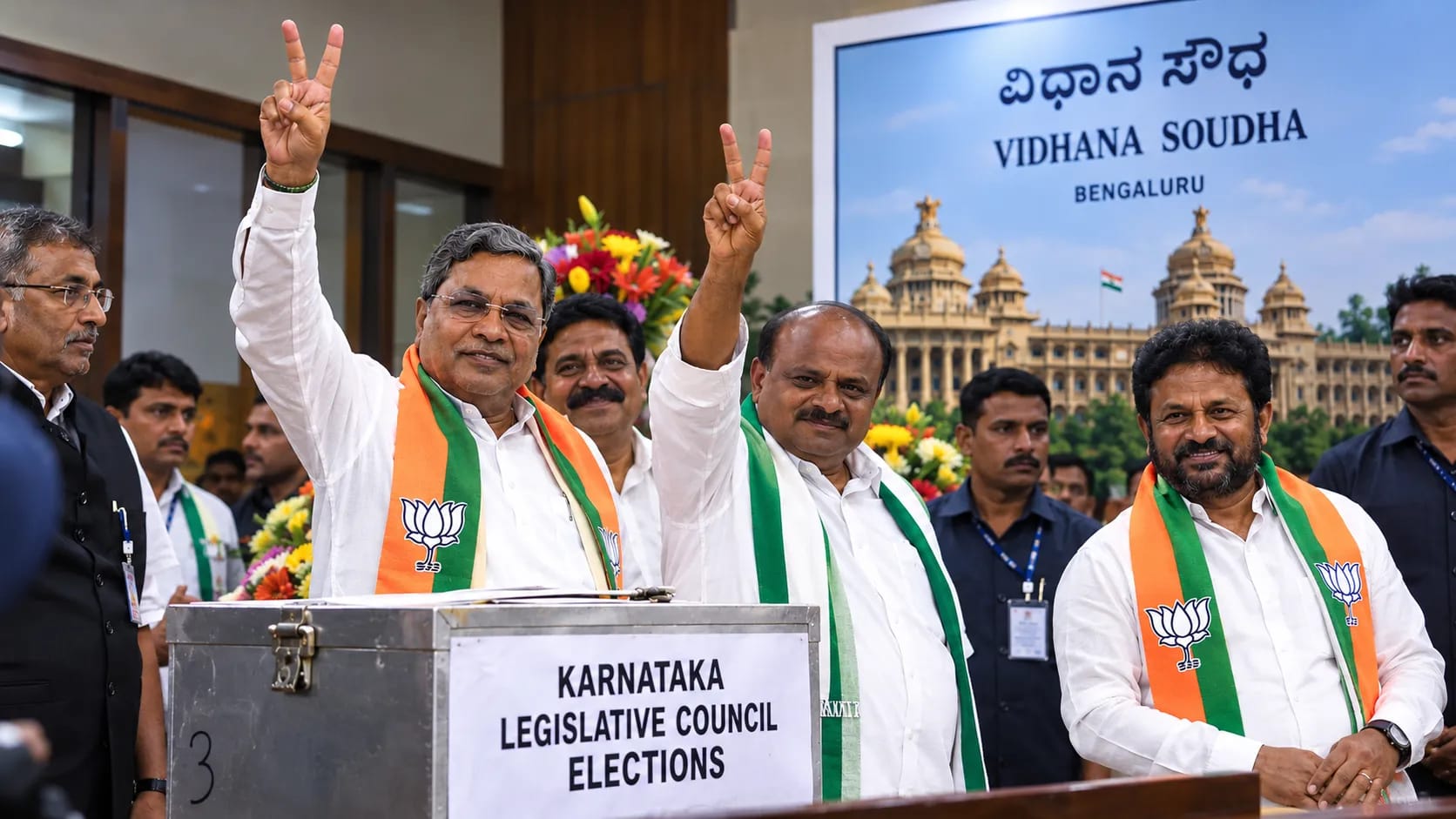
The structural geometry of Karnataka’s upper house experienced a major shift following the conclusion of the biennial Legislative Council counting process on October 28, 2026. The final calculations released by state election officials revealed an absolute sweep by the National Democratic Alliance (NDA), consisting of the Bharatiya Janata Party (BJP) and its partner, the Janata Dal (Secular) [JD(S)]. By winning every single contested seat across the specialized Graduate constituencies and Teacher constituencies, the opposition bloc achieved a key institutional victory.
For the ruling Congress party, led by Chief Minister Siddaramaiah and Deputy Chief Minister D.K. Shivakumar, the outcome serves as a stark administrative indicator.
The most notable symbolic defeat occurred in the state capital, where the five-time sitting MLC Puttanna was unseated in the Bengaluru Teachers' Constituency. This outcome broke a long-standing pattern of personal candidate networks outlasting broader party alignments, demonstrating the strategic impact of the unified opposition campaign.
Micro-Analysis of the Four Contests: Breaking Down the Vote Share
The Bengaluru Teachers’ Constituency: The Fall of an Institutional Stronghold
The race for the Bengaluru Teachers' seat was widely watched as the primary indicator of urban voter trends. The incumbent Congress MLC, Puttanna, had long maintained a resilient cross-party network across the capital city's primary, secondary, and pre-university educational institutions. However, the strategic coordination between the NDA partners changed the typical field calculation.
The JD(S) legal and organizational strategist, A.P. Ranganath, ran a targeted campaign focused directly on administrative delays inside the education department, connecting with voters through local management unions.
When counting officials finalized the preferential ballot paper sheets, the scale of the opposition's mobilization became clear. A.P. Ranganath secured 10,810 first-preference votes, while the Congress’s Puttanna fell short at 9,902 votes. This final winning margin of 908 votes showed that the combined voter bases of the BJP and JD(S) successfully transferred their support to the alliance candidate in a critical urban hub.
The West Graduates’ Constituency: Consolidating the Professional Hub
In the North Karnataka belt, the West Graduates’ constituency saw a clear contest between established tracking systems. The BJP's incumbent representative, S.V. Sankanur, ran on a platform detailing his past contributions to university syndicates and professional employee forums. The Congress party countered by fielding Mohan Limbikai, aiming to capitalize on local discussions regarding employment creation and state regularizations for guest lecturers.
The expected close contest did not materialize during the counting phases. S.V. Sankanur built a steady lead from the initial rounds of sorting, eventually securing a definitive victory over Mohan Limbikai. The win confirmed that the professional and graduate voter base in the Hubballi-Dharwad and neighboring educational belts remained closely aligned with the opposition's structural platform.
The South-East Graduates’ Constituency: A Distinct Mandate
The scale of the NDA's sweep was highly apparent in the expansive South-East Graduates' constituency, a region covering multiple southern districts that combines agrarian communities with growing technology and manufacturing corridors. The BJP's nominee, K.M. Suresh, faced off against Congress’s Shashi Hulikunte Mutt in a seat that saw record high registration numbers among new corporate and professional graduates.
The North-East Teachers’ Constituency: Breaching Regional Bastions
In the Kalyana-Karnataka region, the North-East Teachers' constituency saw the BJP’s experienced leader Shashil G. Namoshi secure his fifth term in the Legislative Council. He defeated Congress's veteran candidate Sharanappa Mattur in a closely watched contest that took place in a historic regional stronghold for senior national Congress leadership.
The Paper Ballot Factor: Shifting the Voting Technology Narrative
A key feature of this election cycle was its complete reliance on traditional paper ballots rather than Electronic Voting Machines (EVMs). Under the Representation of the People Act guidelines for specialized institutional constituencies, voters must explicitly rank their candidates using physical preferential marking systems on paper ballots.
The Strategic Outlook: What Happens Next in the Vidhana Soudha?
The immediate result of this election is a reset of the balance of power within the state legislature. Moving forward, the Siddaramaiah-led administration will need to invest more time in building consensus to pass key legislative proposals. Any controversial bills, particularly those concerning land reforms, labor rules, or municipal governance changes, will face detailed scrutiny from a confident opposition majority in the upper house.


Join the discussion
Comments (0)