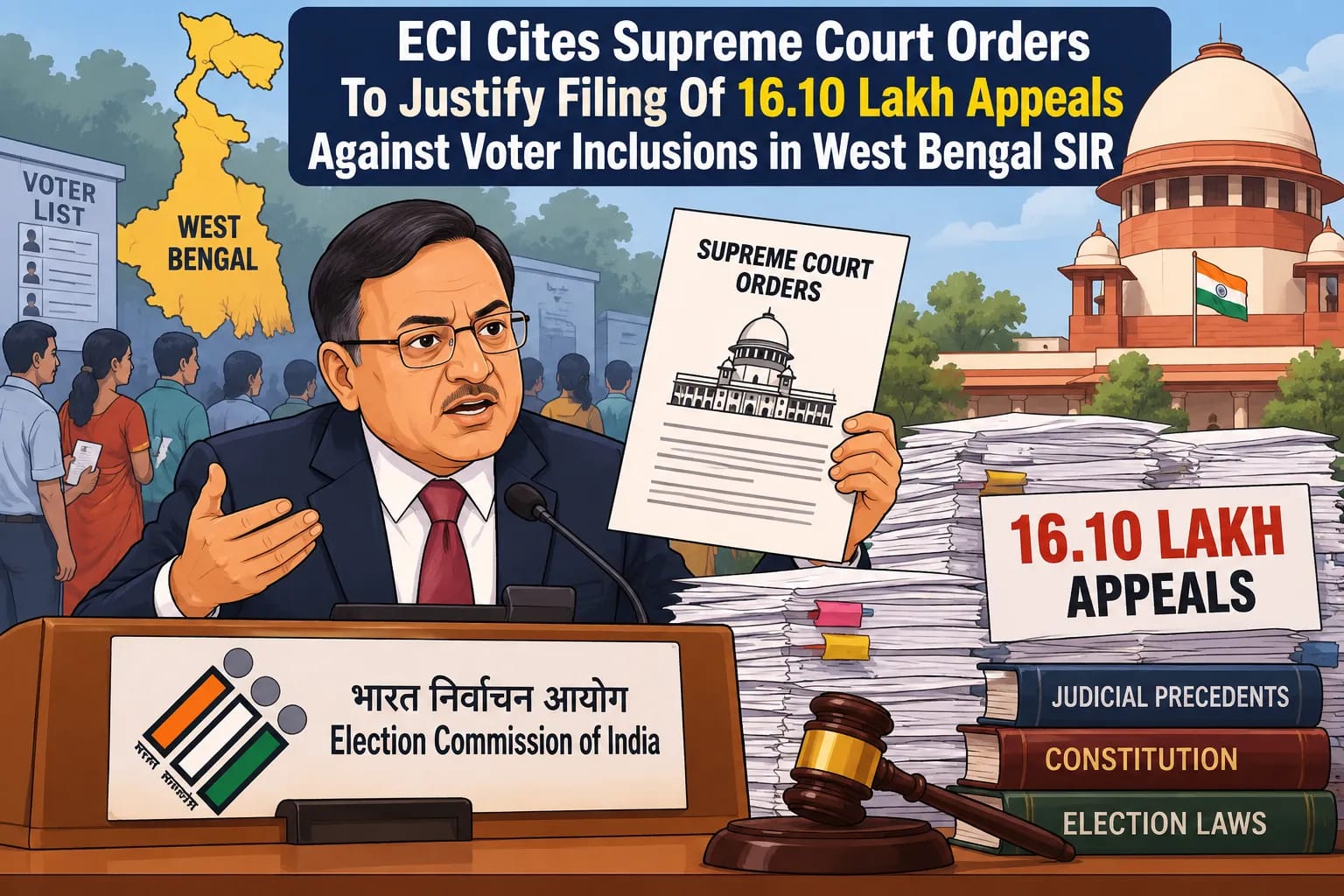
ECI Cites Supreme Court Orders To Justify Filing Of 16.10 Lakh Appeals Against Voter Inclusions in West Bengal SIR
The Core Development
In its comprehensive legal response submitted before the apex court on October 27, 2026, the Election Commission of India (ECI) provided an explicit justification for the massive 16.10 lakh administrative appeals filed concerning voter list inclusions in West Bengal. These extensive cross-challenges were initiated by regional electoral registration offices following initial findings from the Special Intensive Revision (SIR)
To counter political claims of selective scrutiny, the ECI’s legal team referenced specific directives from the Supreme Court, arguing that previous judgements empower state machinery to review voter entries through formal appellate channels to ensure compliance with natural justice.
The Legal Architecture of the Appeals
The commission's formal submission breaks down the complex administrative approach being implemented in West Bengal:
• The Strategic Mandate: The Chief Electoral Officer's (CEO) office in West Bengal acted directly under the procedural rules set out by the Supreme Court to verify voter consistency.
• Tribunal Framework: The 16.10 lakh cases are routed through localized appellate tribunals tasked with analyzing field reports without disrupting everyday polling administration.
• Resolution Status Updates: Similar deep-cleaning strategies in other states have yielded results; for instance, out of 97 disputed voter cases in Goa, 88 names were successfully verified and re-enrolled after correct documentation was provided.
The Political Battle in West Bengal
The state's ruling Trinamool Congress (TMC) has strongly opposed the move, describing the 16.10 lakh challenges as an excessive bureaucratic burden that risks leaving legal residents without a voice. The party contends that the process creates unnecessary hurdles for rural and economically vulnerable populations.
In contrast, the main opposition block in West Bengal supports the comprehensive review, asserting that strict verification is essential in border states to maintain the validity of the electoral roll.
What Happens Next?
The regional appellate tribunals across West Bengal are establishing dedicated review schedules to handle the massive volume of cases. Under the Supreme Court's active observation, these panels must evaluate each challenge individually, ensuring that no legitimate voter is removed without a fair hearing.





Join the discussion
Comments (0)