Delimitation Bill 2026: 850 Lok Sabha Seats Proposed, but Constitutional Reform Hits a Parliamentary Roadblock
Introduction: A major proposal meets a constitutional hurdle
India's parliamentary representation debate entered a significant phase in 2026 when the Union government introduced legislation proposing a new framework for delimiting electoral constituencies and expanding the maximum strength of the Lok Sabha.
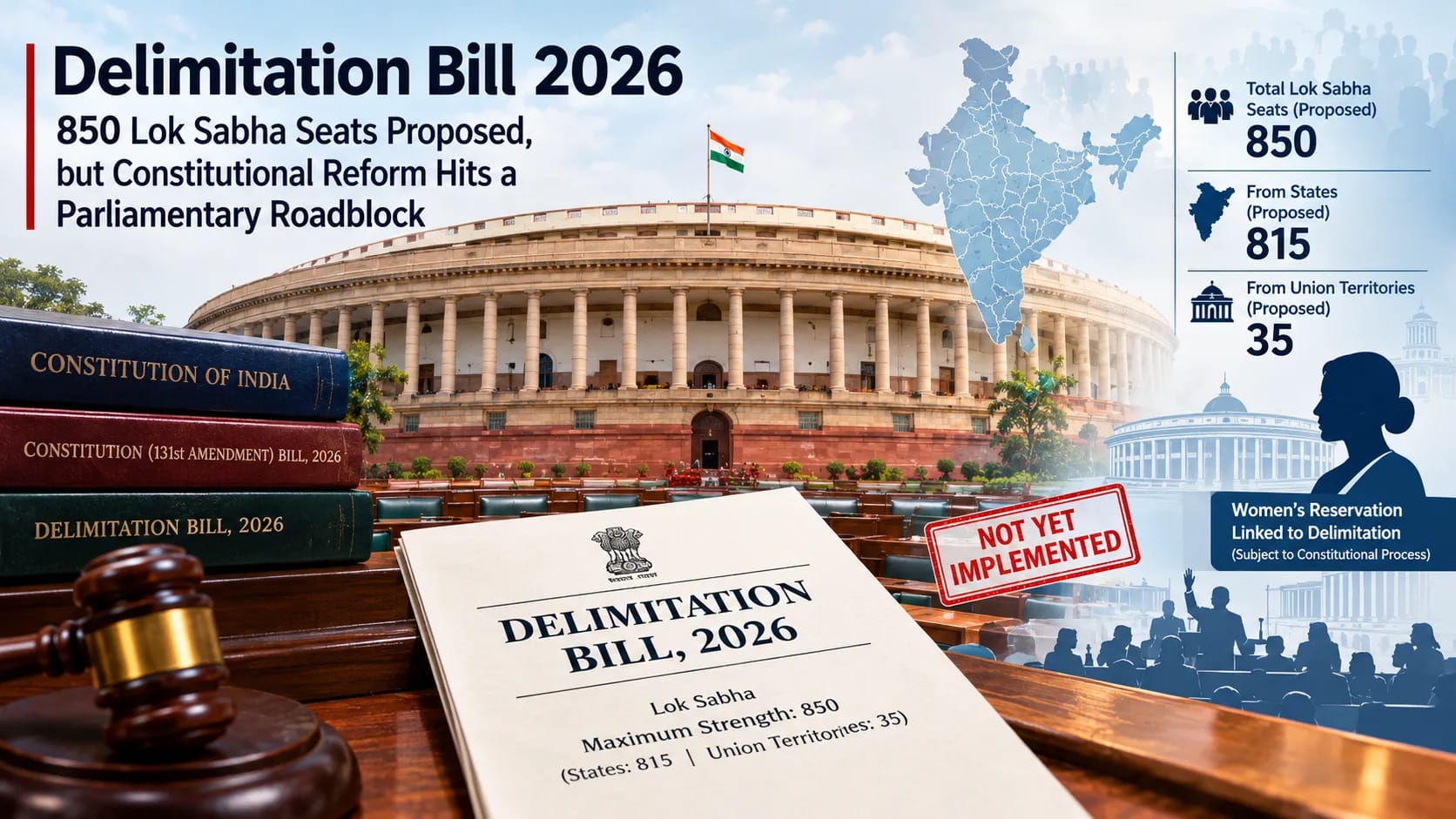
The proposed changes were substantial. The Delimitation Bill, 2026 envisaged a maximum of 850 Lok Sabha members, including up to 815 members representing states and up to 35 representing Union Territories. The accompanying constitutional proposal also sought to alter the legal framework governing the implementation of women's reservation in elected legislatures.
However, the most important development is not simply the proposed increase in seats. According to the Ministry of Parliamentary Affairs' account of the 2026 Budget Session, the Constitution (131st Amendment) Bill, 2026 did not secure the required majority under Article 368(2) when put to consideration. The two dependent bills—the Union Territories Laws (Amendment) Bill, 2026 and the Delimitation Bill, 2026—were consequently not proceeded with.
What did the Delimitation Bill propose?
Delimitation refers to the process of defining electoral constituency boundaries and determining the allocation of seats among states and Union Territories under the applicable constitutional and legal framework.
The Delimitation Bill, 2026 proposed a new framework for readjusting the allocation of Lok Sabha seats, determining the strength of state legislative assemblies and redrawing territorial constituencies.
Its proposed maximum Lok Sabha structure was:
Total maximum strength: 850 members.
Maximum representation from states: 815 members.
Maximum representation from Union Territories: 35 members.
The bill also proposed a mechanism for constituting a Delimitation Commission. The introduced text provided for a chairperson who is or has been a Supreme Court judge, along with election officials specified in the legislation.
Why did the constitutional amendment matter?
The delimitation proposal was linked to the Constitution (131st Amendment) Bill, 2026, which sought to change the legal framework surrounding women's reservation in legislatures.
A constitutional amendment requires the special majority prescribed by Article 368 of the Constitution. Such a bill cannot be treated as enacted merely because it has been introduced or debated.
The federal question: How would seat allocation affect states?
Any future restructuring of parliamentary seats would raise important questions about the relationship between population, representation and federal balance.
India is a union of states with different populations, geographical characteristics, demographic trends and development histories. A major change in the allocation of parliamentary seats could alter the number of MPs representing individual states and the relative distribution of seats in the Lok Sabha.
These questions are especially important for states that have experienced different rates of population growth. Any future proposal would need to be examined through its actual legal provisions and seat-allocation methodology rather than assumptions about which states would gain or lose.
The women's reservation connection
The 106th Constitutional Amendment Act, 2023 provides for reservation of approximately one-third of seats for women in the Lok Sabha and state legislative assemblies, subject to the commencement provisions set out in the Act.
The constitutional framework originally linked the commencement of the reservation to a delimitation exercise following the first census conducted after the Act's commencement.
The 2026 constitutional proposal sought to change that framework. It was therefore connected to both women's representation and the proposed restructuring of electoral constituencies.
The government and opposition debate
The proposal raised a broader policy question: how should India reconcile the objectives of representation, women's political participation and federal balance?
A complete account of the opposition's position requires direct statements from the relevant parties or members of Parliament. It would be inaccurate to attribute a single uniform position to all opposition parties without documentary evidence, particularly because regional parties may have different concerns about representation and the constitutional framework.
Conclusion
The Delimitation Bill, 2026 placed parliamentary representation, federal balance and women's reservation at the centre of an important constitutional debate. Its proposed 850-seat ceiling was significant, but the official parliamentary record shows that the linked constitutional amendment did not secure the required majority and the dependent bills were not proceeded with.
For Indian democracy, the central issue remains how future electoral reforms can balance fair representation, constitutional requirements and women's participation in elected institutions.
.




Join the discussion
Comments (0)