
Karnataka MLC Election 2026: BJP-JD(S) Alliance Faces Crucial Test of Vote Transfer

Karnataka MLC Polls Become a Test for BJP-JD(S) Alliance
The upcoming Karnataka Legislative Council elections are emerging as an important test of the BJP-JD(S) alliance ahead of the 2028 Assembly elections, with the two parties attempting to demonstrate that their partnership can translate into effective vote transfer on the ground.
Four Council seats from the Teachers’ and Graduates’ constituencies will go to polls on October 23, 2026, with counting scheduled for October 27. The contest covers the South-East Graduates’, West Graduates’, North-East Teachers’ and Bengaluru Teachers’ constituencies.
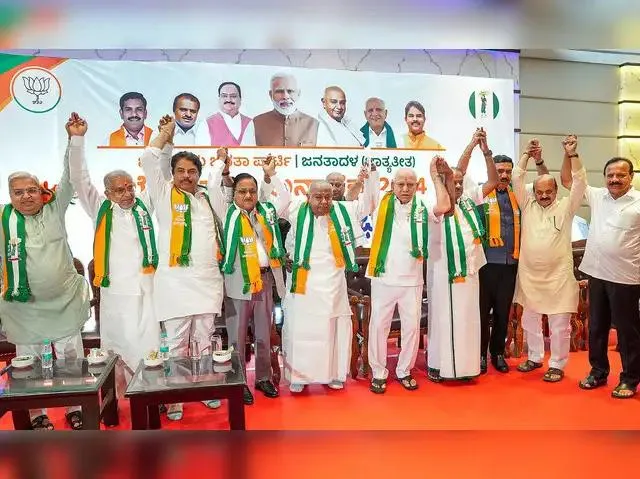
The BJP and JD(S) have decided to contest the election together under the NDA banner. The BJP is contesting three seats, while JD(S) has been given the Bengaluru Teachers’ constituency.
The arrangement is significant because the alliance is not simply dividing seats. In three constituencies, JD(S)-leaning voters are expected to support BJP candidates, while in Bengaluru Teachers’, BJP voters will be expected to back the JD(S) nominee.
That makes the election an early practical test of whether the two parties can successfully transfer their respective support bases to one another.
BJP and JD(S) Agree to Contest Together
The BJP and JD(S) formally decided to contest the four Council seats together in September.
Karnataka BJP president B Y Vijayendra said both parties would work jointly to win all four constituencies. Senior leaders from the two parties also discussed coordinated political programmes and a common strategy against the Congress government.
The alliance has since moved into the campaign phase, with leaders assigning responsibilities across the constituencies.
Former Karnataka Chief Minister B S Yediyurappa reiterated on October 5 that BJP and JD(S) would contest upcoming elections in Karnataka together and field candidates as the NDA. His statement came ahead of the Council polls and reinforced the broader political significance attached to the alliance.
Three Seats for BJP, One for JD(S)
The seat-sharing arrangement gives BJP the larger share of the four constituencies.
The BJP has fielded:
K M Suresh — South-East Graduates’
S V Sankanur — West Graduates’
Shashil G Namoshi — North-East Teachers’
JD(S) has fielded:
A P Ranganath — Bengaluru Teachers’
The Congress has fielded:
Shashi Hulikuntemutt — South-East Graduates’
Mohan Limbikai — West Graduates’
Sharanappa Mathur — North-East Teachers’
Puttanna — Bengaluru Teachers’
The four constituencies therefore present direct contests between the NDA alliance and Congress.
Bengaluru Teachers’ Is the Most Important Alliance Test
Among the four constituencies, Bengaluru Teachers’ carries particular significance for the BJP-JD(S) alliance.
The seat is being contested by JD(S)'s A P Ranganath, while Congress has fielded sitting member Puttanna.
This is the one constituency where the BJP is not fielding its own candidate and instead has to persuade its voters to support a JD(S) nominee.
That makes the contest an important test of whether BJP voters will transfer their support to an alliance partner.
The reverse test is also relevant in the three seats where BJP candidates are contesting. JD(S) voters will be expected to support BJP nominees even though the BJP and JD(S) have historically had separate organisational structures and voter bases.
Vote Transfer Is the Real Challenge
An electoral alliance can be announced by party leadership, but its success ultimately depends on what happens at the booth level.
The BJP and JD(S) have different historical support bases in Karnataka.
BJP has traditionally maintained a stronger organisation across large parts of the state, while JD(S) has had a particularly strong presence among sections of voters in southern Karnataka.
For the alliance to work effectively, these voter bases need to move beyond their traditional party preferences and support the common NDA candidate.
The Council elections will therefore provide an opportunity to measure whether the alliance's organisational coordination is translating into actual electoral behaviour.
NDA Currently Holds Three of the Four Seats
The stakes are particularly high for the BJP-JD(S) alliance because the NDA currently controls three of the four constituencies going to the polls, while Congress holds Bengaluru Teachers’.
For the NDA, the immediate objective is therefore defensive as well as expansionist.
The alliance wants to retain the three seats already held by the BJP while attempting to capture the Bengaluru Teachers’ seat through its JD(S) candidate.
Union Minister H D Kumaraswamy has said the alliance is aiming to win all four seats.
A clean sweep would give BJP and JD(S) a strong political message heading into the longer campaign cycle before the 2028 Assembly elections.
Congress Sees an Opportunity
For Congress, the arithmetic is different.
The party already holds Bengaluru Teachers’, while the BJP controls the other three constituencies.
Congress therefore has the opportunity to either defend its existing seat or make gains in constituencies where the BJP has historically been stronger.
The party's candidates include former Council members Mohan Limbikai and Sharanappa Mathur, while Shashi Hulikuntemutt is contesting South-East Graduates’.
The Congress campaign will also attempt to turn the election into a referendum on the BJP-JD(S) alliance and the performance of the Karnataka government.
BJP Wants to Consolidate Its Alliance Strategy
The MLC elections come at an important moment for the BJP in Karnataka.
The party is preparing for the 2028 Assembly election, and the alliance with JD(S) is intended to combine the strengths of both parties.
For BJP, JD(S) brings an established political network and influence among sections of the Vokkaliga electorate, particularly in southern Karnataka.
For JD(S), the alliance provides access to the BJP's larger organisational structure and voter base.
The Council elections are therefore an opportunity for both parties to determine how effectively these strengths can be combined.
JD(S) Faces Its Own Test
The election is also important for JD(S).
The party is contesting only one of the four seats, but its candidate is facing a Congress incumbent in Bengaluru Teachers’.
A victory for A P Ranganath would demonstrate that JD(S) can win a constituency with BJP support while operating as part of the broader NDA structure.
A defeat, on the other hand, could raise questions about whether BJP voters transferred their support effectively to the alliance partner.
That is why Bengaluru Teachers’ could attract disproportionate attention during the counting process.
Congress and NDA Fight Over Graduate and Teacher Voters
The electoral composition of these constituencies makes the campaign different from a conventional Assembly election.
The four seats are divided between two Graduates’ constituencies and two Teachers’ constituencies.
Eligible graduates and teachers vote in their respective constituencies, creating a relatively specialised electorate.
Candidates therefore need to focus on issues affecting education, employment, professional recognition and public administration while also maintaining strong organisational networks among eligible voters.
The specialised electorate can also make local candidate reputation particularly important.
The BJP-JD(S) Partnership Has Larger Implications
The outcome of the MLC election will be watched beyond the four constituencies.
BJP and JD(S) have repeatedly emphasised that their alliance is intended to continue across future elections in Karnataka.
Yediyurappa's latest statement that the two parties will contest upcoming elections together reinforces that political direction.
The Council election is therefore an opportunity to test the alliance before the much larger 2028 Assembly contest.
If the NDA wins all four seats, BJP and JD(S) can point to the result as evidence that their partnership is functioning electorally.
If the alliance loses seats it currently holds, questions could emerge over coordination and vote transfer.
Congress Can Benefit From Any Alliance Weakness
Congress will be closely watching the relationship between the two NDA partners.
The party's best opportunity may come not only from expanding its own vote share but also from preventing BJP and JD(S) voters from transferring completely to the alliance candidate.
This is particularly relevant in Bengaluru Teachers’, where BJP voters are being asked to support a JD(S) candidate.
The Congress can use the constituency to test whether the BJP-JD(S) alliance is stronger at the leadership level than among voters.
Karnataka Politics Already Looking Towards 2028
Although the MLC election involves only four seats, its political timing makes it significant.
The next Karnataka Assembly election is scheduled for 2028, and both the Congress government and the BJP-JD(S) opposition alliance are already building their political narratives.
The BJP-JD(S) alliance wants to present itself as a credible alternative to Congress.
Congress, meanwhile, wants to demonstrate that its government and organisation remain capable of defeating a combined opposition.
The MLC election provides both sides with an early opportunity to measure their organisational strength.
October 23 Polls Will Provide the First Major Test
The immediate question is whether the BJP-JD(S) alliance can translate its seat-sharing agreement into votes.
The NDA has set an ambitious target of winning all four seats.
The BJP is expected to carry the main burden in three constituencies, while JD(S) will rely heavily on BJP support in Bengaluru Teachers’.
For Congress, retaining Bengaluru Teachers’ and making gains elsewhere would provide evidence that the party can challenge the combined opposition.
For the NDA, a strong result would strengthen the argument that BJP and JD(S) can work together effectively ahead of 2028.
A Small Election With a Bigger Political Message
The Karnataka MLC election may involve only four constituencies, but its political implications extend much further.
The central issue is no longer simply which candidate wins each seat. It is whether BJP and JD(S) voters are willing and able to transfer their support to each other's candidates.
The answer will be especially visible in Bengaluru Teachers’, where the JD(S) candidate is directly dependent on BJP support.
With polling scheduled for October 23 and counting on October 27, the results will offer one of the clearest early indicators of how well the BJP-JD(S) alliance is functioning at the constituency level.
For Karnataka's major political parties, the MLC results could therefore become an important reference point as preparations for the 2028 Assembly battle gather momentum.





Join the discussion
Comments (0)