
Alliance or Revival? Why Congress Faces a Deep Dilemma in Uttar Pradesh
The Congress party faces a significant political and organisational challenge in Uttar Pradesh ahead of the 2027 Assembly elections. With a limited legislative presence in the state, the party must consider whether to strengthen its independent organisation or continue relying on electoral alliances with the Samajwadi Party (SP), its partner in the INDIA bloc.
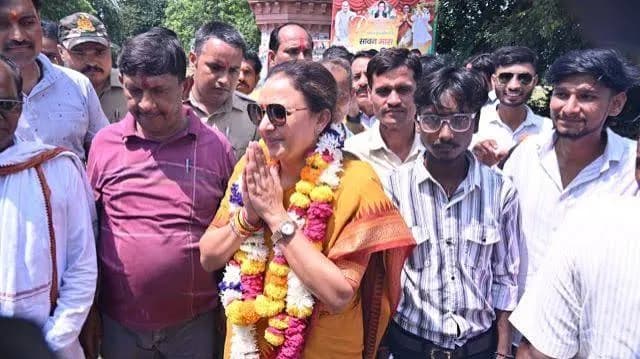
The All India Congress Committee (AICC) has recently reshuffled the Uttar Pradesh Congress leadership, appointing Aradhana Misra as the president of the Uttar Pradesh Congress Committee (UPCC) and Saharanpur MP Imran Masood as working president. The appointments come at a crucial stage as the party prepares for seat-sharing discussions and attempts to expand its political influence in the state.
Aradhana Misra Takes Charge of Uttar Pradesh Congress
The appointment of Aradhana Misra, popularly known as Mona, as UP Congress president represents a change in the party's state leadership ahead of the Assembly elections.
Misra is a three-term MLA representing Rampur Khas and the daughter of Rajya Sabha MP Pramod Tiwari. Her legislative experience and established presence in the constituency form part of the political background to her appointment.
Congress Faces a Choice Between Alliance and Independent Revival
One of the central questions facing Congress is how to balance its relationship with the Samajwadi Party against the need to rebuild its own political organisation.
An alliance can help parties coordinate their electoral efforts, avoid competing against one another in selected constituencies and combine their support among different sections of voters. However, seat-sharing arrangements can also limit the number of constituencies in which a smaller partner contests independently.
Congress's Declining Electoral Presence in Uttar Pradesh
Uttar Pradesh has historically been an important state for Congress, but its political position has weakened over several decades as regional parties expanded their influence.
The rise of the Samajwadi Party and the Bahujan Samaj Party changed the state's political landscape, while the BJP established a substantial electoral presence. These developments reshaped competition for voters across social groups and constituencies.
Congress's reduced legislative representation has raised questions about its organisational strength and its capacity to compete independently across the state.
Organisational Weakness and Grassroots Mobilisation
A major challenge for Congress is strengthening its organisational network across Uttar Pradesh. Electoral campaigns depend on more than prominent leaders; they also require active district committees, constituency-level coordination, local representatives and regular engagement with voters.
A stronger state organisation could help Congress communicate its policies, identify local issues and prepare candidates capable of contesting effectively. It could also provide the party with greater negotiating capacity when discussing electoral alliances.
The appointment of new state leaders provides an opportunity to reorganise the party structure, but measurable progress would depend on the implementation of organisational changes and the party's ability to maintain activity beyond election campaigns.
What the Samajwadi Party Alliance Means for Congress
The relationship between Congress and the Samajwadi Party remains an important factor in the opposition's electoral planning in Uttar Pradesh.
Working together may allow the parties to coordinate campaigns and avoid splitting votes in constituencies where their interests overlap. At the same time, negotiations over seat allocation can become difficult when both parties seek to protect their respective political interests.
The Road Ahead to the 2027 Assembly Elections
The forthcoming Uttar Pradesh Assembly election presents Congress with an opportunity to evaluate its organisational direction and electoral strategy.
The new leadership will need to translate appointments into sustained grassroots work, strengthen constituency-level networks and clarify the party's priorities. At the same time, its negotiations with the Samajwadi Party will influence how Congress balances cooperation with its longer-term goal of organisational revival.
The party's performance will depend on several factors, including its candidate selection, voter outreach, alliance arrangements and ability to address local issues. Its historical electoral record offers useful context, but it cannot by itself determine the outcome of the next election.
Ultimately, the central dilemma for Congress in Uttar Pradesh is how to work with an alliance partner while building an organisation that can sustain its own political presence. The decisions taken before the 2027 Assembly elections will help define the party's approach to that challenge.
Source: The Indian Express
Reporter: Shyamlal Yadav
Published: October 11, 2026, at 3:37 PM IST
Location: New Delhi

Join the discussion
Comments (0)