Rahul Gandhi Detained Again: How Detention Differs From Arrest and What Rights Detainees Have
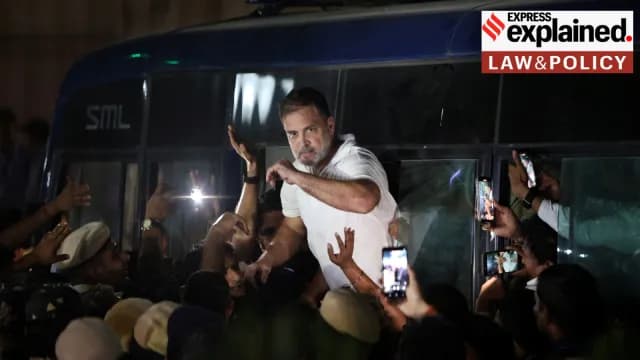
Congress leader and Leader of Opposition in the Lok Sabha Rahul Gandhi was detained by Delhi Police again on October 7, 2026, as INDIA bloc leaders continued their protests in New Delhi demanding the resignation of Chief Election Commissioner Gyanesh Kumar.
The detention came a day after Rahul Gandhi, Priyanka Gandhi Vadra and other Opposition leaders were detained following a protest at Akashvani Bhavan. Police had also registered a case relating to the alleged unauthorised entry into the premises.
The developments have brought renewed attention to an important legal distinction: what is the difference between being detained and being arrested, and what rights does a person have when police take them into custody?
What Is Detention?
The Bharatiya Nagarik Suraksha Sanhita (BNSS), 2023, does not provide a single statutory definition of the word “detention” in the way it defines or regulates arrest.
Police powers under the BNSS can, however, allow officers to temporarily restrain or hold a person in circumstances where intervention is considered necessary to prevent an offence or maintain public order.
For example, Section 170 of the BNSS permits a police officer who knows of a design to commit a cognisable offence to arrest a person without a warrant if the officer believes the offence cannot otherwise be prevented. The law places a 24-hour limit on such preventive custody unless further detention is authorised under another legal provision.
During public demonstrations, the police may also take action to prevent violations of law or to enforce lawful directions. The exact legal basis depends on the circumstances and the provisions invoked by the authorities.
How Is Arrest Different?
An arrest is a formal legal action that places a person in police custody under the authority provided by law.
The BNSS lays down specific procedures for arrest. Section 35 deals with circumstances in which police may arrest without a warrant, while Section 62 states that an arrest must be made in accordance with the BNSS or another applicable law.
An arrest therefore has more formal legal consequences than a temporary police detention during a protest.
A person who is arrested must also be taken before the appropriate Magistrate or the officer in charge of a police station without unnecessary delay, subject to the applicable provisions relating to bail.
What Rights Does an Arrested Person Have?
The BNSS provides several procedural safeguards for people who are arrested.
Under Section 36, the police officer making an arrest must prepare a memorandum of arrest and inform the arrested person that a relative, friend or another person nominated by them can be informed of the arrest, subject to the circumstances specified in the law.
Section 38 provides an arrested person with the right to meet an advocate of their choice during interrogation, although the advocate is not required to remain present throughout the entire interrogation.
The law also requires an arrested person to be taken before a Magistrate or the officer in charge of a police station without unnecessary delay. The BNSS places restrictions on detention beyond the legally prescribed period without appropriate judicial authority.
Why the Distinction Matters in Protest Cases
In political demonstrations, the words “detained” and “arrested” are sometimes used interchangeably in public discussion. Legally, however, the distinction matters because the consequences and procedural safeguards can differ depending on the basis on which police have taken a person into custody.
A temporary detention during a protest does not by itself establish that the person has been formally charged with an offence.
Similarly, an FIR or police allegation does not establish guilt. If an individual is formally arrested in connection with a criminal case, the subsequent process is governed by criminal-procedure safeguards and judicial oversight.
Rahul Gandhi's Recent Detentions
Rahul Gandhi and other INDIA bloc leaders were detained on October 6 after attempting to march towards the Election Commission's office while demanding the resignation of CEC Gyanesh Kumar. The protesters were raising concerns over the Election Commission's Special Intensive Revision of electoral rolls.
The following day, Rahul Gandhi was detained again during another Opposition protest in New Delhi. Priyanka Gandhi Vadra and other Opposition leaders were also detained as the demonstrations continued.
The protests and subsequent police action have added a legal dimension to the wider political dispute over the electoral-roll revision process.
What Happens After Detention?
The legal consequences depend on why the person was detained and whether police subsequently register a criminal case or make a formal arrest.
If a person is arrested, the police must follow the statutory arrest procedure and the person's constitutional and legal safeguards continue to apply. If the person is being temporarily restrained as part of preventive police action, the applicable legal provisions and duration of custody become important.
Therefore, simply being described as “detained” does not automatically mean that a person has been arrested or formally charged with a crime.
Expert View
The Rahul Gandhi episode highlights why the distinction between detention and arrest is important during political protests. While police have statutory powers to prevent offences and maintain order, those powers operate alongside procedural safeguards governing custody, communication with family or friends, access to legal assistance and judicial oversight.

Join the discussion
Comments (0)